
India's exports saw a significant 23 per cent increase, reaching USD 44.4 billion in September, while the trade deficit narrowed to USD 30.21 billion, according to recent government data.

A recently finalised peace deal between the US and Iran, set to be signed on June 19, is expected to significantly benefit India's economy by boosting exports to West Asia, stabilising the rupee, and easing inflationary pressures, according to exporters and experts.
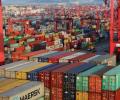
India's trade deficit reached a six-month high of $31.98 billion in July, driven by a sharp increase in imports, particularly crude oil, electronic goods, coal, and fertilisers. Both merchandise exports and imports recorded their second-highest levels during the same period.
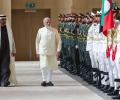
Prime Minister Narendra Modi has offered India's support to bring peace to West Asia during talks with UAE President Sheikh Mohamed bin Zayed Al Nahyan. Both countries signed agreements to strengthen strategic collaborations in energy and defence.

India's merchandise exports experienced a slight decrease in February, while imports surged due to increased gold and silver purchases, leading to a widened trade deficit. The West Asia crisis is expected to further impact trade in the coming months.

Reliance Industries Ltd (RIL) has expressed caution regarding 'extreme volatility' risks stemming from the West Asian conflict, which could impact global oil demand and the company's margins, while also noting that near-term retail consumption demand may remain sensitive to macro conditions. Chairman Mukesh Ambani, in the annual report, remained silent on the timeline for Jio Platforms' anticipated public listing, stating the group will 'continue to evaluate strategic pathways'.
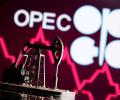
The United Arab Emirates has announced its decision to withdraw from OPEC and the wider OPEC+ alliance, effective May 1, 2026, signalling a significant policy-driven evolution in its long-term energy strategy aimed at aligning with domestic economic goals and increased production investment.
The United Arab Emirates has announced its decision to withdraw from OPEC and the wider OPEC+ alliance, effective May 1, 2026, signalling a significant policy-driven evolution in its long-term energy strategy aimed at aligning with domestic economic goals and increased production investment.

India's exports jumped by 19.37 per cent to $38.13 billion in November, while imports dipped by 1.88 per cent to $62.66 billion, according to government data released on Monday.

The International Monetary Fund (IMF) has reduced India's growth forecast for FY27 to 6.4 per cent, citing the potential impact of higher energy prices offsetting the country's economic resilience. Despite this, India remains among the fastest-growing major economies.
India's exports contracted 11.8 per cent to $34.38 billion in October, showed government data released on Monday. Imports jumped 16.63 per cent to $76.06 billion.

Notwithstanding the economic complementarities and the host of agreements for deepening economic relation on a host of areas, both sides share common viewpoints on the foreign policy domain and seek common grounds to serve as a counterweight to China, notes Dr Rajaram Panda.

After a three-month slowdown, India's oil imports (already landed) from Russia bounced back in the first 15 days of October to 1.8 million barrels per day.

India's merchandise exports dipped by about one per cent to $38.01 billion in December 2024 against $38.39 billion a year ago, according to government data released on Wednesday. Imports increased by 4.8 per cent to $59.95 billion in December 2024 compared to $57.15 billion in the year-ago month.

India's merchandise trade deficit widened to a record $41.68 billion in October, as gold imports trebled and outbound shipments registered their sharpest contraction in 14 months, according to data released by the commerce department.
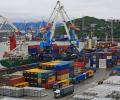
The country's exports rose marginally by 0.61 per cent to $36.56 billion in January, while trade deficit widened to a three-month high of $34.68 billion, government data showed on Monday.

After registering a positive growth for two months, India's exports slipped into negative territory again, contracting 2.17 per cent year-on-year to $38.73 billion in May due to a fall in global petroleum prices, while trade deficit narrowed at $21.88 billion during the month.

'In all these years of rupee depreciation, of rising oil prices, of inflation caused by import dependence, not one leader had the courage to look the people in the eye and say: Please do this for your country.'

The latest decision of the Organisation of Petroleum Exporting Countries and its allies, commonly known as Opec+, to boost output is being seen as an attempt to regain market share lost to the US, Brazil, and other oil producers, who have been increasing production recently.
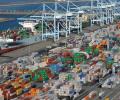
'The immediate impact for India will be very minimal as the share of Venezuela in our total overseas production is very low.'

The Iran-Israel conflict has further increased global economic uncertainties, impacting world trade, including India's exports, as it is expected to drive up both air and sea freight rates, exporters say. They said that India's exports to Europe and counters like Russia may get impacted due to this war.

Qatar Petroleum while confirming the withdrawal, tweeted, "Qatar announces it was withdrawing from the Organisation of Petroleum Exporting Countries effective 1 January 2019."

Indian rupee slipping below the record 88 level against the US dollar will enhance price competitiveness of Indian products in global markets and help exporters diversify beyond the US market, say exporters. However, import-dependent sectors such as gems and jewellery, petroleum and electronics may see lower benefits due to a rise in input costs, they stated.
After the first quarter was washed out, exporters are now keeping their fingers crossed over a turnaround in outbound shipments to at least North America from September onwards. This comes even as other key destinations such as Europe may take longer to revive in FY24. Slowdown in key economies, as well as geopolitical tensions resulted in sluggish demand for Indian goods.

India's merchandise exports in October rose by 17.25 per cent to $39.2 billion against $33.43 billion a year ago, according to government data released on Thursday. Imports increased by 3.9 per cent to $66.34 billion in October compared to $63.86 billion in the year-ago period.
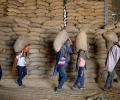
Domestic exporters on Monday expressed concerns over the crisis in Bangladesh and said the developments in the neighbouring country would have implications on bilateral trade. However, exporters expect that the situation may normalise soon. According to exporters, they are already facing disruptions in exports to Bangladesh due to a shortage of foreign exchange in that country.
After remaining in the positive zone for three months, India's exports contracted 1.2 per cent to $33.98 billion in July, while the trade deficit widened to $23.5 billion.

India's merchandise exports in April 2024 marginally rose to $34.99 billion from $34.62 billion in the year-ago month, according to government data released on Wednesday. Imports too increased to $54.09 billion from $49.06 billion in April 2023.
With crude oil flirting with the $100 a barrel mark, world's largest oil producer Saudi Arabia is emulating marketing savvy West to showcase oil cartel Organisation of Petroleum Exporting Countries in a new light when it organises the third OPEC Summit in Riyadh this week.
The Financial Times, London, reports that Nobuo Tanaka, the first Asian head of the International Energy Agency, has stated that the organisation must work more closely with the two Asian giants.

The country's exports dipped 8.74 per cent to $23.52 billion in November on account of contraction in shipments of key sectors like petroleum, engineering, chemicals and gems and jewellery, official data showed on Tuesday. Trade deficit during the month narrowed to $9.87 billion as imports too declined by 13.32 per cent to $33.39 billion.
The Indian industry is paranoid about the USA's plan to impose reciprocal tariffs and wants early conclusion of a bilateral trade agreement, sources said on Wednesday. They said that the talks for the proposed bilateral trade agreement are going well.
The Organisation of the Petroleum Exporting Countries (OPEC) has decided to cut its daily oil production by about 2 million barrels. OPEC's daily output target is 27.3 million barrels.
India's exports declined by 2.83 per cent to $33.90 billion in November this year compared to $34.89 billion a year ago, government data released on Friday showed. Imports also declined to $54.48 billion in the month under consideration, as against $56.95 billion recorded in November 2022.
OPEC, which has oil reserves that constitute 80 percent of the total global reserves, is unwilling to increase output to bring down oil prices. This makes OPEC too responsible for the rising oil prices, apart from the weak dollar. OPEC has said that world oil demand this year is forecast to grow by 1.2 million barrels daily to an average of 87 million barrels per day. As OPEC's output remains insufficient to cover rising demand from Asian region, oil prices will tend to rise.
The Third OPEC Summit on its closing day on Sunday is likely to announce a fund, which will have contributions from energy consuming countries and oil producers, to provide technological support for reduction of the environmental impact of fuel use, OPEC officials said.
